General Hardware
Piston and Standard Convolution
Width Dimensions
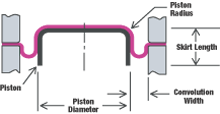
Diameter
(Inches)
Diameter
( mm )
( Inches )
( mm )
Convolution Width
( Inches )
Convolution Width
( mm )
2
2
2
2
Piston Cap Dimensions
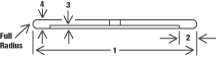 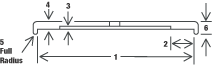
|
Cylinder
Diameter
( Inches )
Cylinder
Diameter
( mm )
( Inches )
( mm )
( Inches )
( mm )
( In )
( mm )
( In )
( mm )
( In )
( mm)
(Diaphragm Thickness)
Required
Required
Required
Required
(Diaphragm Thickness)
(Diaphragm Thickness)
(Diaphragm Thickness)
Bonnet Dimensions
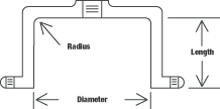
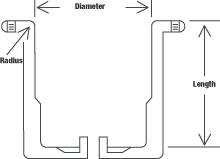
(Diaphragm Gauge)
Upstroke
2
Cylinder Dimensions
Diameter
( Inches )
Diameter
( mm )
( Inches )
( mm )
Piston Skirt
Piston Skirt
Piston Skirt
Piston Skirt
Flange Retention Methods for Type F and FC Diaphragms
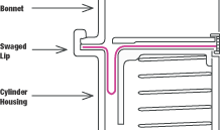
Swaged Lip— Lending itself to high volume/low cost, the swaged lip resembles the crimp ring in design except that the lip is an integral part of the cylinder or bonnet. Lip should be flexible and thin to insure proper flange retention. Type F Diaphragm | Type FC Diaphragm
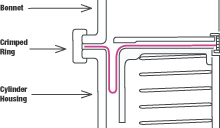
Crimped Ring— This method lends itself to high volume and low cost manufacturing. It utilizes a separate metal crimp ring and is assembled to the unit with special crimping tools. These crimp rings are made of thin, ductile materials so that the force required to form the lip will not overcompress the diaphragm flange area.
Flange Retention Methods for Type D and DC Diaphragms
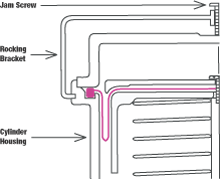
Pivoted Rocking Bracket— This method provides quick assembly and disassembly. The pivoted rocking bracket is attached to the housing flange, and the central jam screw secures the bonnet against the mating flange. Type D Diaphragm | Type DC Diaphragm
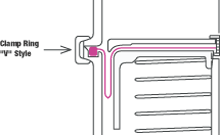
Ring Clamp— “V” style clamp rings can be disassembled quickly by removing a clamp lever. A retainer plate is removed by turning it 90 degrees where two “wings” and a retaining screw drop into a keyhole.
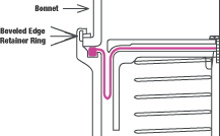
Beveled Edge Retainer Plate — eliminate the need for flange bolts as a beveled edge ring is snapped into a groove in the extension of the cylinder housing flange. This loads the bonnet assembly onto the mating bead, generally producing low clamping forces.
Flange Retention Methods for Type O and OA Diaphragms
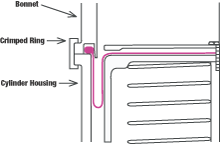
Crimped Ring — Used in high volume, low cost applications, this method eliminates typical flange construction and flange bolts. Type O Diaphragm | Type OA Diaphragm
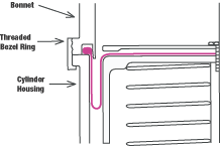
Bezel Ring — This common method provides minimum clearance of the housing outside diameter. Male threads are machined on the cast bonnet to utilize drawn sheet metal cylinder housings, reducing costs.
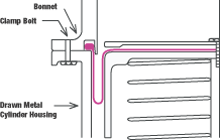
Grooved Bonnet — This method requires a sufficient number of circumferential clamp bolts so distortion does not occur between flange bolts. It is advisable to make provisions for the bead groove in the cast or molded bonnet.
For Product Inquiries & Information Only:

