Diaphragm Glossary & Design Formulas
Hardware
Convolution Width
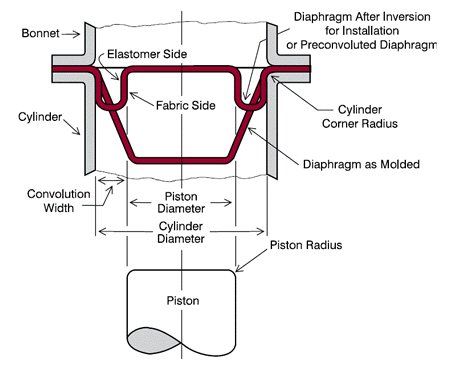
The clearance between the cylinder wall and piston skirt. By decreasing the convolution width, higher working pressures may be achieved. Generally, the convolution width should measure at least four times the diaphragm's sidewall thickness.
Cylinder Diameter (Bore)
The inside diameter of the cylinder into which the diaphragm will fit and by which the outside diameter of the convolution will be supported.
Cylinder Radius
The blend radius between the cylinder wall and the flange.
Piston Cap
A plate which attaches to the piston, sandwiching the piston area of the diaphragm insuring the diaphragm stays in convolution.
Piston Diameter
Diameter of the piston measured across piston head, including radius.
Piston Radius
The blending radius between the piston head and the piston skirt.
Piston Skirt
The sidewall area of the piston which supports the inside diameter of the convolution.
Diaphragm
Cylinder Diameter
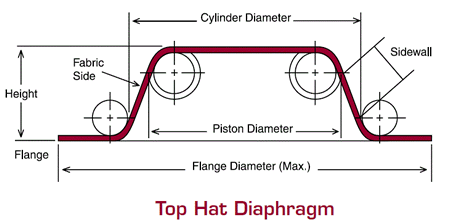
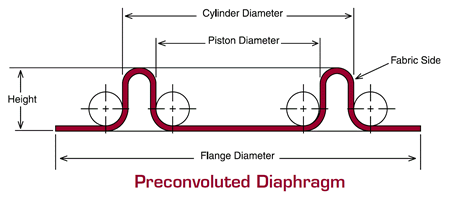
The diameter across the diaphragm between the tangent points of the sidewall and cylinder radius.
Fabric Side
Surface of single coat diaphragm where fabric is visible. Always on low pressure side, generally on outside of diaphragm.
Height
The height of top hat and preconvoluted diaphragm is measured from the bottom of the flange to the top of the head or convolution.
Piston Diameter
The diameter across the diaphragm between the tangent points of the sidewall and piston radius. Measured on the fabric or low pressure side of the diaphragm.
Preconvoluted
A diaphragm which has its convolution molded in. No hand forming is necessary before installation.
Sidewall
That area of the diaphragm between the flange and piston areas.
Top Hat
A diaphragm molded in standard "hat" shape that must be formed into convolution before installation.
Function
Bleedthrough
A defect in a diaphragm caused during manufacturing where the fabric is pulled through the rubber to the high pressure side of the diaphragm. When pressure is put on the diaphragm, the rubber will be blown away from the fabric and rupture.
Blowthrough
This occurs when the pressure on the diaphragm reaches a level high enough to blow a piece of the rubber through the threads of the fabric, causing a leak. This is the result of selecting a weave of fabric that is too open for the diaphragm's thickness.
Double Coat
This is a type of diaphragm construction where the fabric is inserted between two layers of rubber.
Effective Pressure Area
The area of the diaphragm inside an imaginary circle to the convolution midpoint on which the pressure introduced is transmitted to the opposite side of the diaphragm.
Overstroke
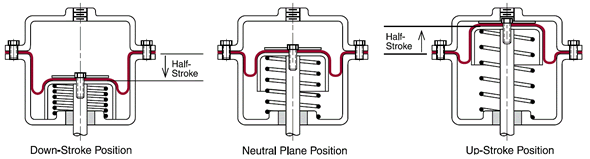
Exceeding the designed stroke of the diaphragm, causing it to come out of convolution. This can be avoided by designing mechanical stops into your hardware.
Reverse Pressure
When the pressure on the low pressure side of the diaphragm exceeds the pressure on the high pressure side of the diaphragm. This will cause the convolution to collapse and wrinkle. This wrinkle will cause scrubbing and lead to premature failure.
Single Coat
This is a type of diaphragm construction where there is rubber in the high pressure side and fabric on the low presure side.
Spring Rate
This refers to the forces caused by the rubber trying to return to its as-molded position. This is generally found only in preconvoluted and dish-shaped diaphragms.
Strikethrough
This refers to the amount of rubber that comes through the fabric to either fully or partially encapsulate the fabric during manufacturing.
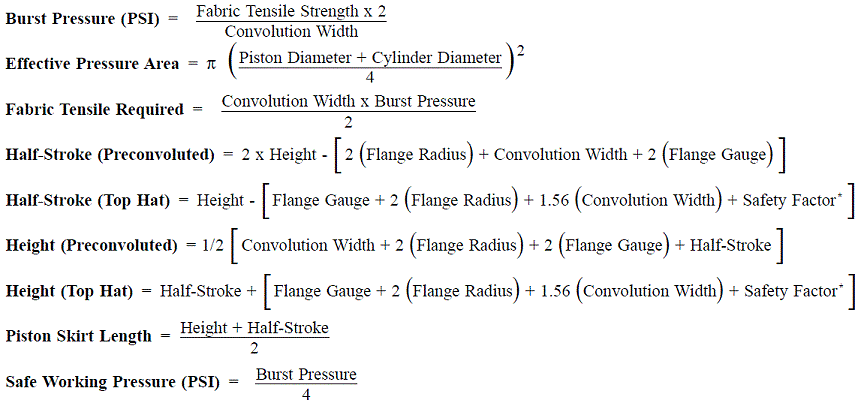
Diaphragm Design Formulas
.99
25.15
2.50
63.50
4.00
101.60
8.00
203.20
Diaphragm Strokes
For Product Inquiries & Information Only:

